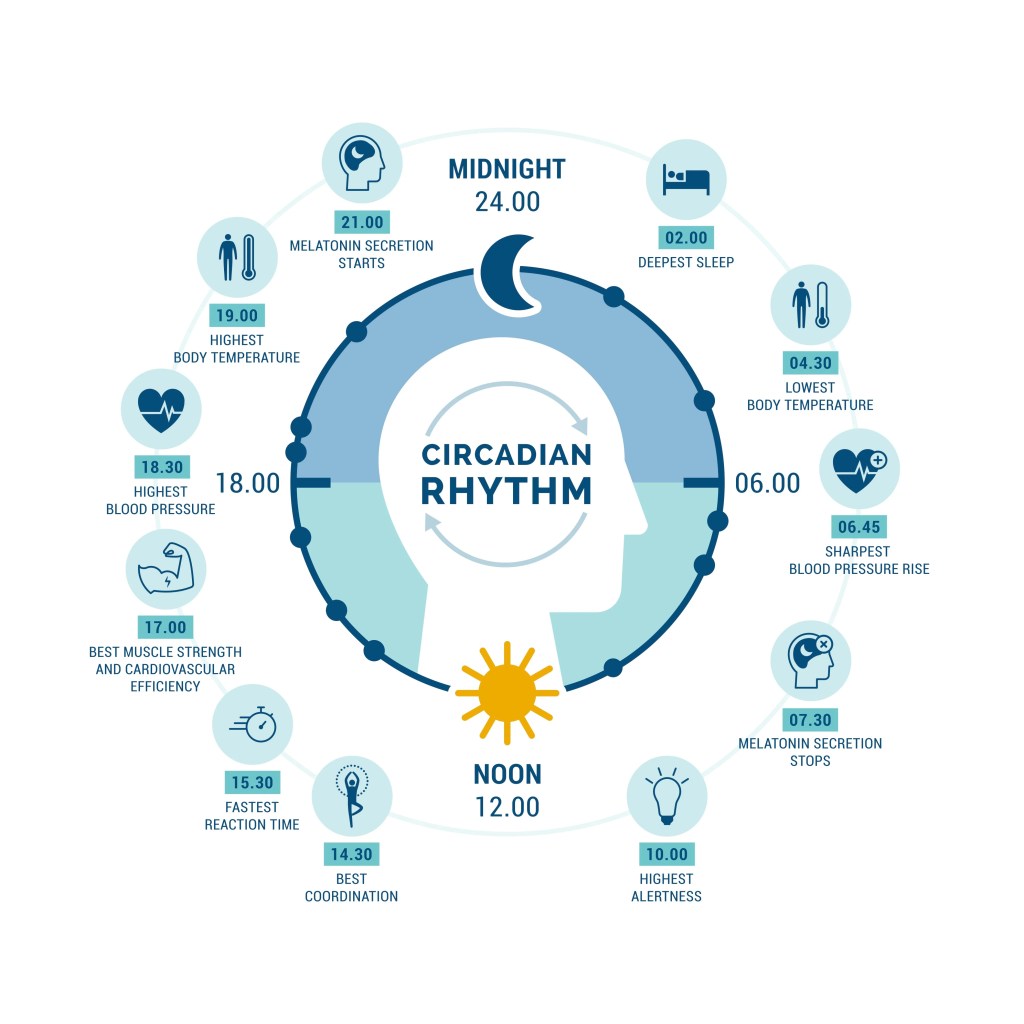
Many women struggle to sleep as they transition into Menopause. The reason this happens is due to the change in our Circadian Rhythm due to the disruption caused to our HPA axis (explained in my blog “Inflammation and what to do about it “).
Circadian Rhythm is basically our sleep/wake cycle and many systems and cells in our bodies have their own circadian rhythm which can become disrupted during Menopause, but also just as we age.
The diagram shows how a normal Circadian Rhythm occurs and how this impacts various systems of our bodies. Our endocrine system (hormones secreted by our endocrine glands) regulates this cycle to a large extent, and if these hormones become dysregulated, so too does our sleep.
In order to keep our Circadian rhythm regular there are many factors involved. But one of the biggest is Nutrition.
Did you know that what we eat has a huge impact on our sleep quality and particularly during Menopause? I didn’t until I started learning more about Menopause and Nutrition.
Even once I was on HRT, I learnt that if I ate the wrong things, my sleep would be disrupted and this would set off a chain of reactions resulting in me feeling exhausted, unable to exercise or focus on work with sore joints and muscles and low mood.
Melatonin production is key to good quality sleep (this is the hormone that gets us off to sleep) and Adenosine is the one which keeps us asleep, so when you are lying awake at 3 am think of all the other thousands of women doing the same, it may help you not to feel quite so alone! But there are foods you can eat which will help. These are foods high in Tryptophan, which is a precursor to Melatonin (it is used by our bodies to make Seratonin and then converted to Melatonin in a very complex series of reactions).
If you eat Tryptophan rich foods for your evening meal and make sure you eat early enough to allow your system to digest before bed (at least 3 hours) this should help enormously with sleep. These include: Wholegrain Rice, Salmon (buy wild caught if you can), Turkey, Quinoa, Buckwheat, spinach, Seeds; such as Pumpkin, Sesame, Sunflower, Chia and Flax, Oats.
Some other animal proteins are rich in Tryptophan as well, but large amounts of animal protein are Thermogenic (create heat when digested) so best avoid protein heavy meals at night (just eat a small portion if you are going to have meat) otherwise you may have hot flushes (alcohol can also be a factor too).
Another nutrient which can help you get a restful nights sleep is Magnesium. This is used in the process of muscle relaxation along side Calcium (involved in muscle contraction). Magnesium can help you relax, dilates blood vessels (thereby reducing blood pressure) and is involved in supporting healthy nerve and muscle function.
Magnesium rich foods include: Almonds, Brazil nuts, Cashews, Pumpkin seeds, Leafy green vegetables, Wholegrains legumes (kidney beans, lentils). Another great way of getting Magnesium is to take a relaxing bath in Epsom salts – we absorb magnesium through our skin, and the combination of warm water (not too hot) and Magnesium are very relaxing.
In order to stay asleep we need Adenosine, which is a neurotransmitter. Many studies have been undertaken to establish the effects of Caffeine on sleep and it has been proven that when Caffeine is taken at night close to bedtime, sleep was disrupted, this was due to the effect Caffeine has on Adenosine (Robilliard et al.,2015). Therefore it is wise to avoid caffeinated drinks (alcohol has a similar effect on Adenosine) towards the afternoon and evening (about 6 hours before sleep). Eating sugary snacks and other refined carbohydrates will also effect your Circadian Rhythm and are best avoided after mid-day.
Swap out White Pasta and Rice for Wholegrain versions, this will also provide more fibre (most people in the UK do not eat enough fibre) and swap White Bread for Wholegrain Sourdough. Wholegrains have a lower Glycaemic index and take longer to digest. They do not cause such a spike in your blood glucose levels (which is not what you need when your body needs to rest at night).
Finally, stop eating at least 3 hours before bed, this gives your gut a chance to rest and cleanse itself overnight rather than having to concentrate on digesting food which will be turned into excess energy which will be stored as fat, either in the liver or around the abdomen. I will talk more about fatty liver and abdominal fat in future blogs.
There are other factors effecting sleep such as day light and the effect of using screens on your melatonin production, as well as stress and Cortisol levels. But in this blog I wanted to focus on Nutrition and its role in our sleep quality as this is something people are not always aware of.
Please feel free to reach out with any questions in the meantime or to book a discovery call free of charge.
Contact me on email: Nicky@nickydearhealthcoach.com
Call me: 07407281148






Leave a Reply